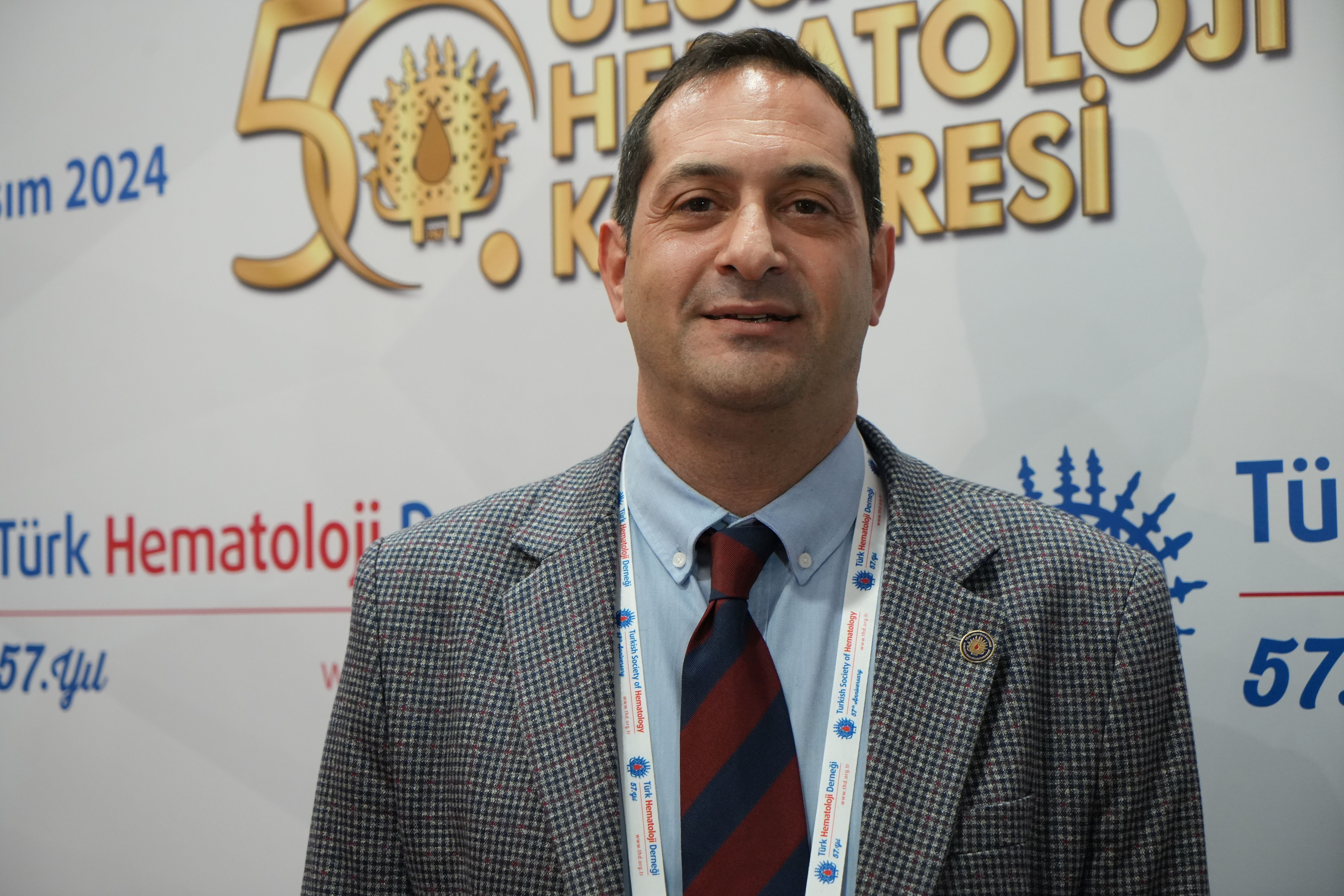
Stating that more targeted, personalized treatments are developing in hematologic cancers, THD President Prof. Dr. Muhlis Cem Ar said, “There are new classifications of blood cancer, genetically based classifications. We are entering a period of more targeted, personalized treatments.”
Turkish Hematology Association (THD) President Prof. Dr. Muhlis Cem Ar, who is in Antalya for the 50th National Hematology Congress, emphasized that they held the 50th congress of the association founded in 1967 and gave information about the congress. Ar said, “The Turkish Society of Hematology is 57 years old, celebrating its 50th congress this year. It was an important milestone for us, a congress that we carefully prepared. Our professors, speakers and researchers from both international and national arena attended. It was a very productive congress with good discussions, where the most up-to-date state of science was discussed in the field of hematology.”
“Movement reduces the risk of clotting”
Prof. Dr. Muhlis Cem Ar stated that they discussed vascular occlusion and clotting at the congress and said that inactivity is one of the main reasons that increase and facilitate clotting. Ar continued as follows: “Vascular occlusion is an important public problem, blood clotting, diseases such as heart attack, stroke, pulmonary embolism caused by clotting are one of the most important causes of death in the world. In our congress, there were sessions on vascular occlusion and clotting, which were also discussed here. Of course, apart from treating what is happening, it is necessary to prevent it from happening. For this, lifestyle changes, proper nutrition and exercise are important. Because we know that inactivity greatly increases the risk of clotting. There was a cartoon, a visual study on this. There, they asked which causes the most deaths. One of the options was cigarettes, one was a hamburger, and the other was a chair. Sitting, in other words, staying still is the most common cause of clotting or one of the reasons that facilitate clotting. We need to emphasize this especially. In other words, it is necessary to take at least 5-6 thousand steps a day. If you work sitting down, you should get up and move every 2-3 hours. Movement significantly reduces this risk of clotting.”
“Entering the era of personalized treatment”
Stating that they held a joint session with the European Society of Hematology in the international part of the program, Prof. Dr. Muhlis Cem Ar stated that genetic-based classifications of blood cancer are one of the popular topics. Ar said, “We held a joint session with the European Society of Hematology at the congress. Many things are changing in the field of hematology and treatment. Immunotherapies are getting involved, treatments using the immune system. But on the other hand, a lot is changing in terms of diagnosis. While in the past we used to look at diseases under a microscope and differentiate them according to their shape, now it is possible to find out at a much finer, molecular level which genetic mutation caused the cancer. With a study conducted by both the World Health Organization and other expert organizations in 2022, a new classification was made in Acute Myeloid Leukemia, a type of blood cancer. This is a completely genetic-based classification. You need to screen for those genetic mutations, and whichever genetic mutation is present, you need to choose a treatment regimen appropriate for that mutation. In this way, you both increase success and have the chance to treat the patient in a short time with targeted therapies with much fewer side effects. The most important problem here is that genetic tests are very expensive all over the world. Not only in our country but also in many other countries, these tests are not easily applicable or feasible. We recently worked on a joint algorithm with the Ministry of Health, and probably as a result of that, at least the genetic tests that we can access through standard screening have become more easily reimbursable and feasible. We think that this will greatly increase the standard of care for patients and make a significant contribution to their treatment success. We do not act like a single type, a single diagnosis and a single treatment as in the past. There is a different drug recommendation according to genetic classifications. We seem to be entering an era of more targeted, personalized treatment. In this context, we devoted the session we held with the European Society of Hematology to Acute Myeloid Leukemia and Myelodysplastic Syndrome (MDS) and discussed these issues. It was an extremely productive meeting.”
İHA Haber Kodu: 20241104AW322076