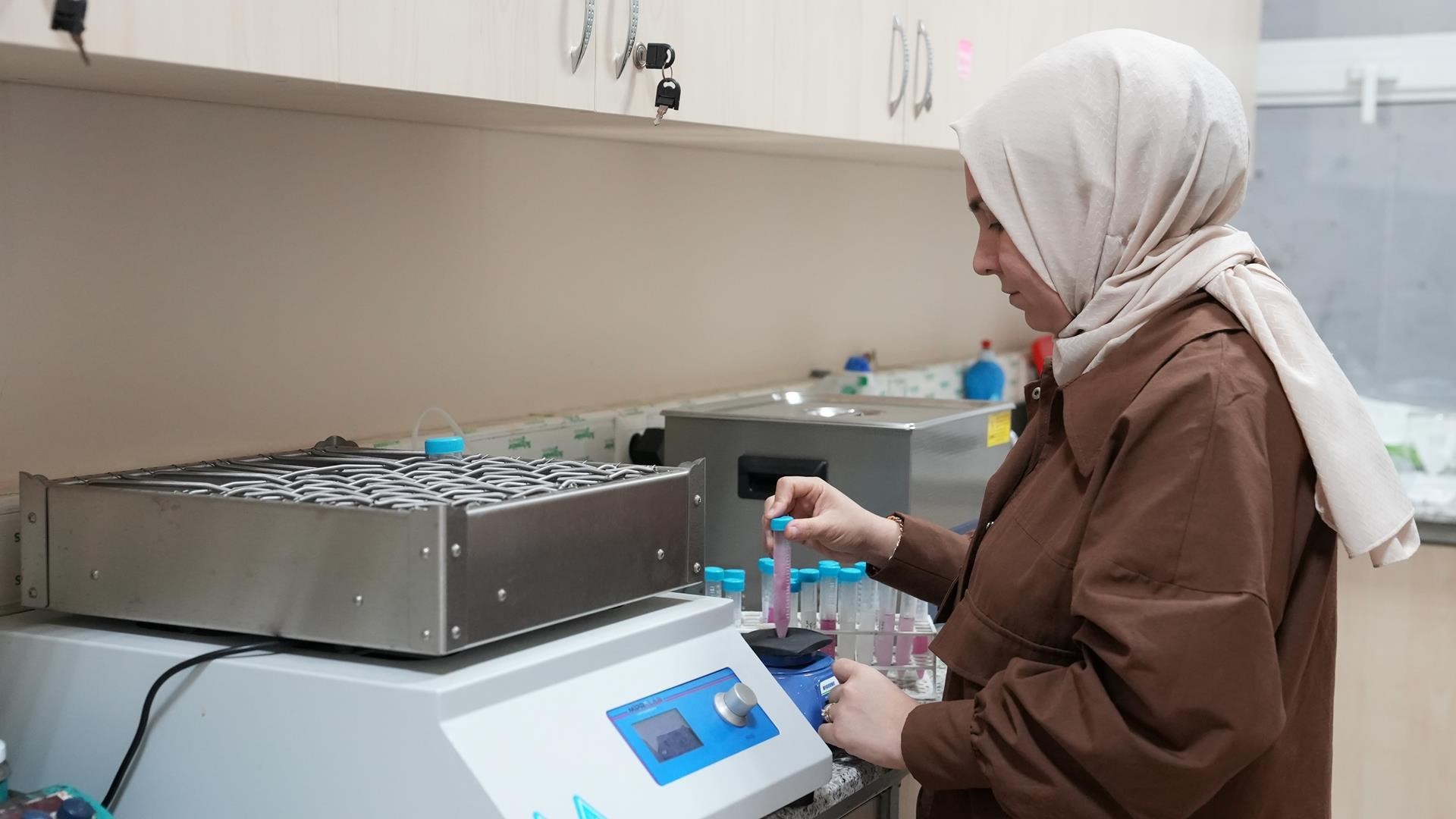
Prof. Dr. Mukaddes Kılıç Bayraktar from the Faculty of Health Sciences, Department of Nutrition and Dietetics, said that with the project they researched, they are working to develop new functional products by obtaining a high value-added product from wheat bran, which emerges as waste during the processing of Siyez wheat.
Prof. Dr. Mukaddes Kılıç Bayraktar from the Faculty of Health Sciences, Department of Nutrition and Dietetics, the project titled “Comparison of Siyez Wheat Arabinoxylans with Modern Wheat and its Effect on Large Intestine Microbiota” was entitled to receive support within the scope of TÜBİTAK 2218 domestic postdoctoral research scholarship program.
The project aims to examine the effects of Siyez wheat, one of Turkey's ancient agricultural products, on human health in comparison with modern wheat varieties. In particular, it is aimed to obtain important findings for the protection and improvement of intestinal health by evaluating its effects on the large intestine microbiota. This study on the nutritional components of Siyez wheat and especially its arabinoxylan content will emphasize the importance of functional foods and reveal how valuable traditional food sources are for modern societies.
In this project supported by TÜBİTAK, it is planned to develop new approaches in the field of nutrition by obtaining important data on intestinal health.
Prof. Dr. Mukaddes Kılıç Bayraktar from Karabük University Faculty of Health Sciences, Department of Nutrition and Dietetics, gave information about her project supported by TÜBİTAK 2218 Domestic Postdoctoral Research Fellowship Program. Bayraktar stated that the main title of her project is “Comparison of Siyez Wheat Arabinoxylans with Modern Wheat and its Effect on Large Intestine Microbiota” and emphasized that consumer demands have turned towards more natural and functional foods in recent years.
Stating that Siyez wheat is an alternative ancestral seed to modern wheat, which offers digestive system regulating effects with its high protein content and low glycemic index, Prof. Dr. Mukaddes Kılıç Bayraktar said, “Siyez wheat, as it is known, is one of the ancestral seeds. Siyez wheat is actually an alternative to modern wheat with its high protein content, low glycemic index and digestive system regulation properties. However, contrary to popular belief, scientific research needs to be conducted to investigate what kind of positive or negative effects it has on human health. In our studies, we realized that there was a deficiency in this regard.”
Stating that the effects of arabinoxylans in wheat bran on the large intestine microbiota will be investigated in the project, Bayraktar said, “Arabinoxylans are actually wheat bran formed during wheat processing, which is generally not considered as waste, but it is a product that emerges as waste. However, it is very valuable in terms of dietary fiber and arabinoxylans constitute an important part of this dietary fiber. How their consumption affects the microbiota of the large intestine will be the focus of this project. How can we make it useful, can we turn it into a functional food by turning it into a value-added product, which is grown in your region and has not been studied much, and which also has such a waste part? Can we turn it into something useful for human health? This is actually the aim of the project.”
Bayraktar said, “If we can obtain a high value-added product from this waste food, we will use this product to develop new functional products. We will hopefully use Siyez arabinoxylans in the development of functional products. After consuming this, how does it affect our intestinal health, which is called the second brain? Which microorganisms does it affect the development of here? We will investigate its effects on our large intestine health.” Finally, Bayraktar stated that he plans to carry the knowledge and experience in this field to Karabük University and said, “After a year of work, we aim to contribute to our university by establishing our own laboratory.”
