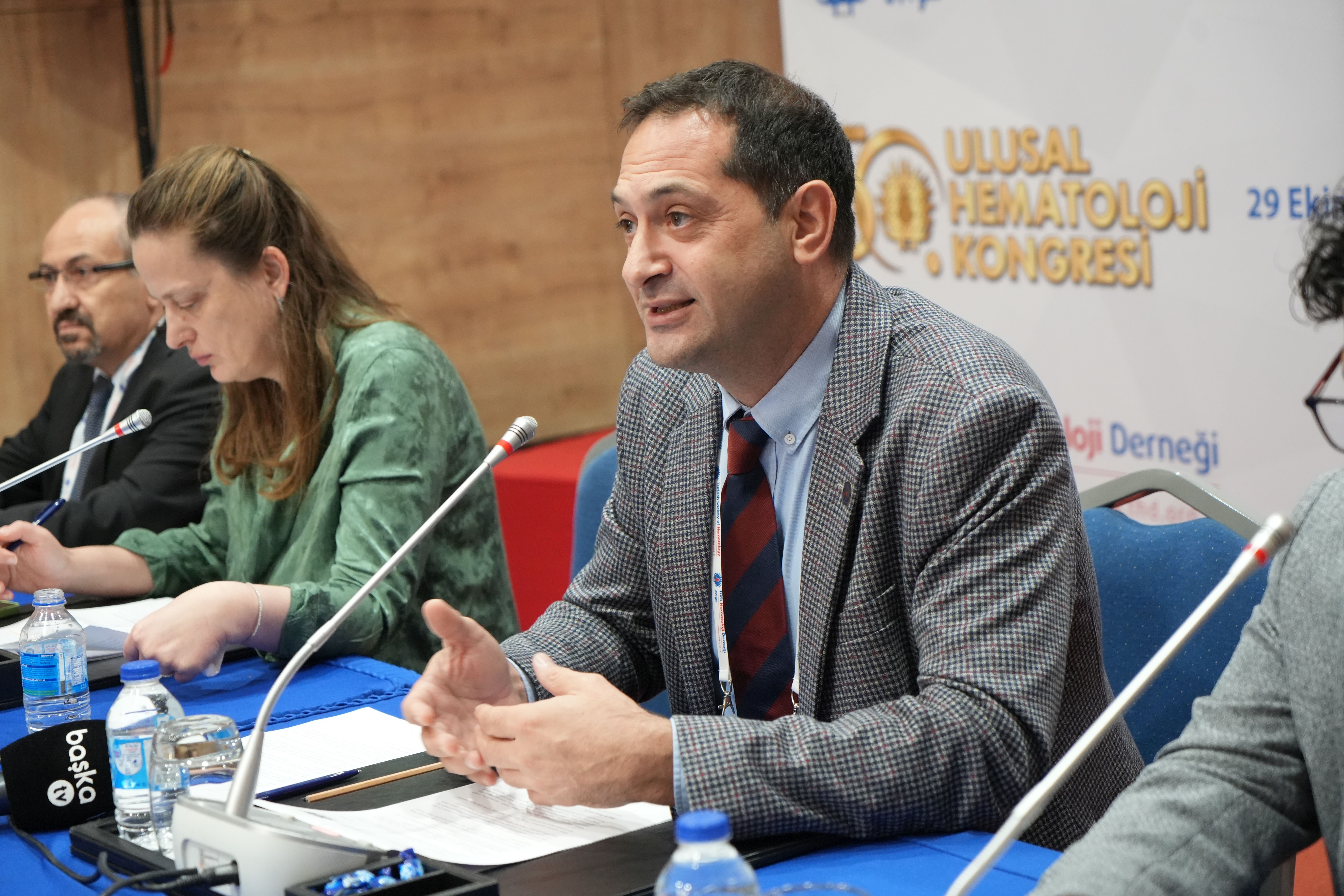
Speaking at the press conference held within the scope of the 50th National Hematology Congress organized by the Turkish Society of Hematology (THD), Turkish Society of Hematology President Prof. Dr. Muhlis Cem Ar emphasized that colonoscopy or endoscopy should be performed for anemia in the elderly. Ar said, “In the elderly, patients with coronary artery or vascular occlusion use blood thinners. An invisible side effect of these blood thinners is micro bleeding. We need to be vigilant about this, and sometimes we try to explain it as due to the aspirin or blood thinner you are using, especially if there are no changes in the patient such as weight loss, loss of appetite or changes in stool. After a certain age, it is absolutely necessary to have a colonoscopy or endoscopy, because the possibility of seeing cancers related to the digestive system increases.”
THD Second President Prof. Dr. Şule Ünal Cangül pointed out that anemia due to iron deficiency is an important public problem and underlined the danger it poses to pregnant women. Cangül said, “In pregnant women with iron deficiency, not only the pregnant woman remains anemic. The baby to be born also faces iron deficiency problems in the first two years of his life. Since it uses the mother's store, if the mother's iron is deficient, the baby will also be born with iron deficiency.”
The 50th National Hematology Congress of the Turkish Society of Hematology was held at a hotel in Serik, Antalya. The congress, which is the most important organization in the field of hematology science, started with 2 separate training programs, “Applied Flowing Cell Meter Course with Cases” and “Erik Frank-Orhan Ulutin Hemostasis Laboratory Course”. A total of 43 scientific sessions, including 10 oral presentations and 5 poster sessions with discussions, and 12 satellite symposia were held at the congress held between October 29 and November 2, 2024.
“There are new classifications of blood cancers”
At the press conference held on the last day of the congress; THD President Prof. Dr. Muhlis Cem Ar, THD Second President Prof. Dr. Şule Ünal Cangül, THD Secretary General Prof. Dr. Özgür Mehtap and THD Board Member Prof. Dr. Emin Kaya made statements about hematology and the fields they work in. Prof. Dr. Muhlis Cem Ar drew attention to their pride in organizing the congress for the 50th time on the dates coinciding with the Republic Day and made the following statements “Since our congress also coincided with October 29th, we had made a plan to include it. As every year, there was an extremely intense scientific program this year. This year, a very large number of scientific researches were submitted to our congress. The referees really had difficulty in evaluating and selecting. But 10 oral sessions and nearly 60 papers were presented and discussed orally. Approximately as many controversial posters were also discussed in the poster areas. There was a very rich program with scientific sessions and satellite sessions. This year we had a joint session with the European Hematology Association. One of the hot topics is that there are new classifications of blood cancers, genetically based classifications. We don't treat them as one type, one diagnosis and one treatment as we used to. According to these genetic classifications, there is a different drug recommendation for each genetic imitation. We seem to be entering an era of more targeted, personalized treatments. In this context, we devoted a session with the European Society of Hematology to acute myeloid leukemia and MDS and discussed these issues. It was a very productive meeting.”
“In pregnant women with iron deficiency, not only the pregnant woman remains anemic”
Prof. Dr. Şule Ünal Cangül, in her speech titled “Why is Iron Deficiency Anemia Important?”, stated that anemia means anemia and that iron deficiency seen in many citizens in Turkey is caused by anemia and Mediterranean anemia. Pointing out that both diseases are public health problems, Şule Ünal Cangül said, “A public health problem means that if a problem concerns more than 5 percent of the society, we call it a public health problem. Iron deficiency is a public health problem in this respect. Because 40 percent of pregnant women, 30 percent of women of childbearing age and 40 percent of children have iron deficiency. The fact that a problem is frequent and its consequences are important makes it important. In pregnant women with iron deficiency, not only the pregnant woman is anemic. The baby to be born also faces iron deficiency problems in the first two years of its life. Since it uses the mother's store, if the mother's iron is deficient, the baby will be born with iron deficiency. Again, problems such as birth complications, premature birth, low birth weight are also affected by the lack of iron in the mother and the size of the pregnancy. Therefore, we need to prevent iron deficiency in this respect, we need to prevent it in pregnant women.”
“If school success is low in children, we need to consider iron deficiency”
Prof. Dr. Şule Ünal Cangül underlined that iron deficiency in infants and children can have important consequences and continued as follows “Iron deficiency in infancy also has extremely important consequences. We want our children to be on time, wondering whether they sit, walk or talk. We are even happy if it happens early. What happens, for example, in babies with iron deficiency? Delay in speech, delay in developmental steps, failure to achieve something when other children have achieved something are some of the consequences. When there is a delay in developmental stages and infancy, we need to think about iron deficiency again. If the child's school success is low, we need to think about iron deficiency again. Children with insomnia, irritable children, all of these can be small signs of iron deficiency. Again, iron deficiency is a condition that also has neurological functions. Iron is not only related to anemia, it actually has both neurological and immunological extra functions. A child with iron deficiency has more frequent infections. Therefore, when our child starts kindergarten, families complain that he/she gets infections very often. Not severe infections, of course, but it causes them to have mild to moderate infections a little more frequently. The infected child may again be malnourished, again deficient in iron and become ill in a vicious cycle. Therefore, it is necessary to look at children at certain points, especially to see if they have developed iron deficiency.”
“Infancy and adolescence are the periods when iron production should be increased”
Prof. Dr. Şule Ünal Cangül stated the main causes of iron deficiency as follows: “If we look at it in terms of every age group, the first reason is low intake. Especially nutritional deficiencies, malnutrition, malnutrition. The second most common cause is bleeding. Especially in adults, bleeding is more prominent. In children, nutritional deficiencies are more prominent. We especially see iron deficiency in children in the first 2 years of life and then in adolescence. Because, when we grow fast, we need to make 70 cc of blood per kilogram. Therefore, we need iron. Since infancy and adolescence are periods of rapid growth, iron production should be increased. People with intestinal absorption problems may also be predisposed to iron deficiency. Therefore, a number of projects are being carried out in Turkey to prevent this. One of them is the “Turkey as Iron” project carried out by the Ministry of Health. Imagine a baby born weighing 3 kilograms, reaching 10 kilograms at the age of 1 year. None of us gain 3 times the weight in one year in our lives. Therefore, it is a period of very rapid growth. In line with the recommendations of the World Health Organization, a project was launched, called the “Turkey as Iron” project. In this way, iron deficiency rates, which were around 30 percent in this period, were reduced to 7 percent. Of course, it could not be zero. Why? Because since this is a preventive dose, it is given in a very low dose, and the compliance of the family and the mother with the drug may not be sufficient. Pregnancy is another period when we do prophylaxis, that is, when we give iron for prevention, and this is carried out especially under the management of obstetricians and family physicians.”
“Approximately 25 percent of deaths are related to thrombosis”
Prof. Dr. Özgür Mehtap, in his speech on vascular occlusion, stated that thrombosis is defined as the formation of a clot in the body, vein, artery or vein, and that one in every 4 deaths in the world is due to vascular occlusion. Mehtap said, “Approximately 25 percent of deaths are thrombosis-related, that is, clot-related. This may be due to many underlying causes. Especially cancers, inactivity, and some genetic conditions may be in question. In other words, there may be what we call family predisposition to thrombosis. In these cases, thrombosis does not always occur, but we encounter factors that can increase it, for example. For example, when there is an intervening disease or surgery, clots can form in such veins and we may encounter life-threatening situations. These clots that form in the veins, especially in the leg veins, can be thrown into the lungs and cause sudden death with a condition called pulmonary embolism. Apart from that, of course, artery-related clots can cause strokes. It can also cause heart attacks. There are many underlying causes.”
Noting that the most important way to reduce the cause of death due to vascular occlusion is to increase movement, Prof. Dr. Özgür Mehtap added that attention should be paid to nutrition and avoid fatty foods.
“Blood cancers such as leukemia can be detected quickly”
In his speech titled “Cancer Diagnosis in Seconds with Artificial Intelligence”, Prof. Dr. Emin Kaya noted that artificial intelligence applications in the field of hematology, which covers a wide range of diseases from cancer to anemia, will break new ground in 2024. Kaya said, “Thanks to innovative artificial intelligence platforms, cancer cells are detected within seconds, access to clinical trials is accelerated and patients' treatment processes are personalized. AI-powered microscope analysis enables detailed and rapid examination of blood cells. In these analyzes, the structural differences of cells can be determined within seconds thanks to image processing algorithms, and blood cancers such as leukemia can be detected quickly. Especially in cancer types such as leukemia, where cell proliferation is rapid, early diagnosis significantly increases the chances of treatment. While these artificial intelligence-supported systems provide great precision in distinguishing abnormal cells in blood samples, they surpass traditional methods with accuracy rates of up to 90 percent. Thus, doctors can make quick decisions and start treatment at the earliest stage, which offers hundreds of patients the opportunity for life-saving intervention.”
Referring to the “Car T Cell” treatment approach, Prof. Dr. Kaya said, “Here, especially specific targeted cells are developed, which need to be planned differently for each patient. Here again, we can create faster and more appropriate targeted treatments with artificial intelligence.”
Turkish Hematology Association is working on artificial intelligence
Delivering the closing speech of the press conference, Prof. Dr. Muhlis Cem Ar, President of the Turkish Society of Hematology, explained the program they are working on in the field of artificial intelligence. Ar said, “As an association, we have 16 scientific subcommittees. It consists of committees working in different fields of hematology, where researchers and physicians working in those fields come together. We established the 17th one on artificial intelligence. Here, as an association, we are working to develop a number of projects that use artificial intelligence on a national basis, and to see if we can integrate artificial intelligence into areas such as diagnosing, diagnosing, and using the right guidelines. We have another study on this subject. In fact, we were going to launch it at this congress, but since the trials could not be completed, it was left for the next congress. We are creating a program that uses artificial intelligence as a software with a diagnosis and treatment program. The first skeleton has been completed. The part where it will direct the incoming patient to which disease group in terms of hematology has been completed. Now, for each disease group, scientific subcommittees will work and create algorithms specific to it. Thus, when the patient arrives, it will first lead to a diagnosis, then guide on how to classify the risk, and when that risk is determined, which treatment is appropriate, and even whether the Health Implementation Communiqué (SUT) pays for that treatment or not? Or is it accessible in Turkey or not? What is available in the world? Are there any clinical studies in Turkey on this subject? We are trying to make it a program that can be used in a very wide scope,” he said.
“Microbleeds, an unseen side effect of blood thinners”
Answering the question about what anemia means in the elderly, Prof. Dr. Muhlis Cem Ar stated that endoscopy or colonoscopy should be performed for anemia in individuals over a certain age. Prof. Dr. Ar said, “In the elderly, patients with coronary artery or vascular occlusion use blood thinners. They do not see any visible blood, but there may be hidden blood in the stool, which we can call occult blood. We need to be vigilant about this, sometimes we try to explain it as a result of the aspirin or blood thinner you are using, especially if there are no changes in the patient such as weight loss, loss of appetite or changes in stool. Especially after a certain age, despite everything, a colonoscopy or endoscopy should be performed in these patients. Because the possibility of seeing cancers related to the digestive system increases.”
İHA Haber Kodu: 20241103AW321365
