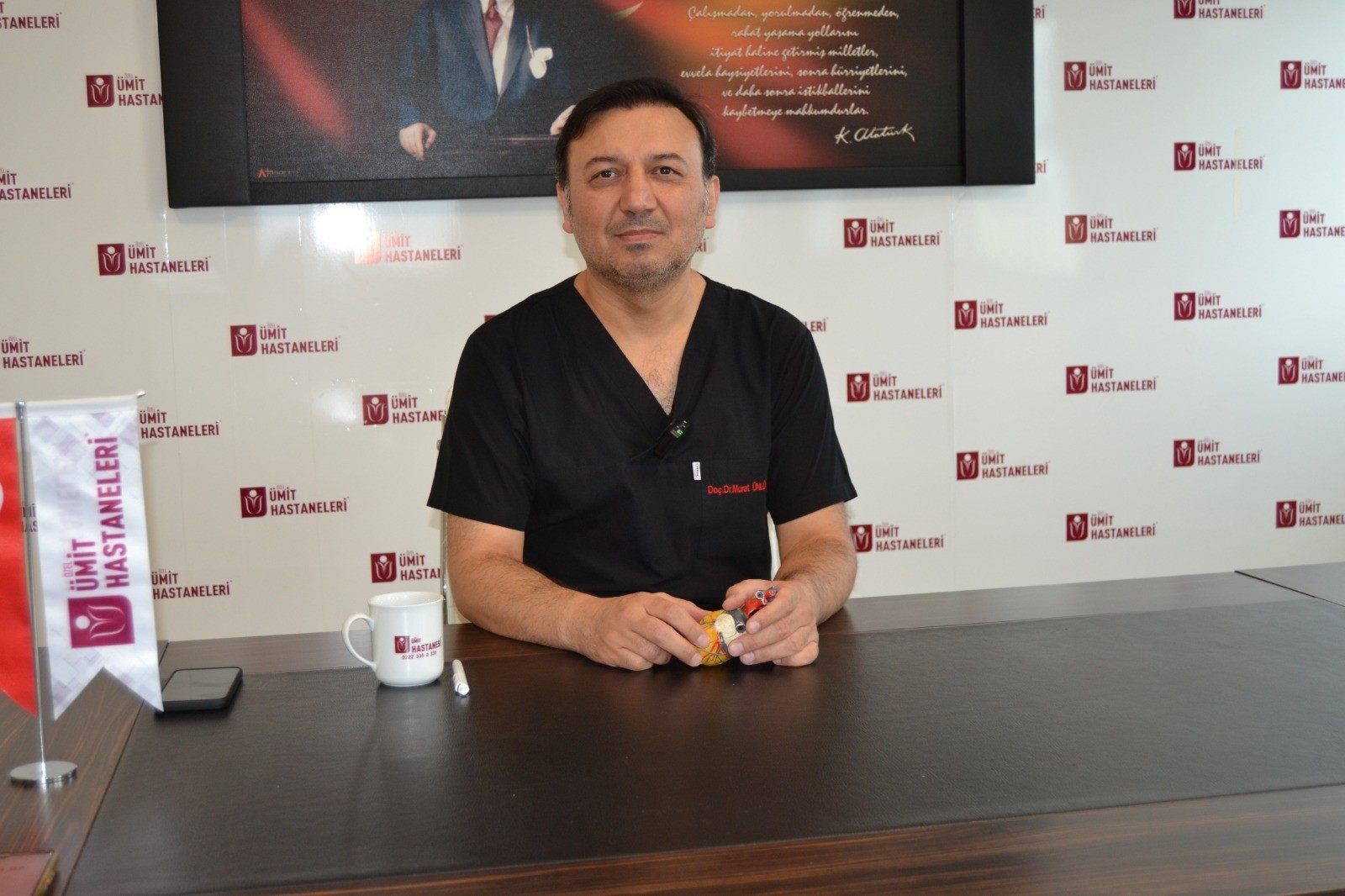
Private Ümit Batıkent Hospital Cardiology Specialist Assoc. Prof. Dr. Murat Ünlü explained in which cases a pacemaker is implanted and said, “These are smart devices like a small computer. When there is any abnormality in the rhythm of the heart, the device first tries to regulate the rhythm of the heart. If this does not work, it gives an electric shock, corrects the fatal rhythm disorder and speeds up the heart when the heart slows down.”
Stating that the heart is an organ that adjusts the number of contractions by producing its own electricity and pumps the blood the body needs, Assoc. Prof. Dr. Murat Ünlü said that patients are implanted with pacemakers when there is an insufficiency or pause in the production of electricity that starts the heart's excitation. Assoc. Prof. Dr. Ünlü said, “These are very small devices, almost the size of a wristwatch. Their lifespan is between 8-10 years. It is inserted under the skin just below the patient's left collarbone with a half-hour procedure under local anesthesia while the patient is awake and the patient is discharged 1 day after the procedure.”
“It gives an electric shock to the heart”
Assoc. Prof. Dr. Ünlü stated that the size and types of pacemakers vary according to the type of heart disease and the extent of dysfunction in the heart and said, “Some pacemakers only stimulate the heart electrically by giving electric current to the heart. These have a longer lifespan and are small devices. Pacemakers, which are implanted in cases of serious life-threatening arrhythmias or heart failure, are slightly thicker and high-voltage pacemakers that additionally deliver electroshocks. High-voltage pacemakers monitor the heart one-to-one. They are smart devices, like a small computer. If there are any abnormalities in the heart rhythm, the device first tries to regulate the heart rhythm. If this does not work, it gives an electric shock, corrects the fatal rhythm disorder and speeds up the heart when the heart slows down.”
“Protects the heart against rhythm disorders”
Stating that 3-wire pacemakers are especially installed in heart failure patients, Assoc. Prof. Dr. Murat Ünlü continued as follows:
“The pacemaker I mentioned increases the contractile power of the heart and protects the heart against rhythm disorders. In addition, it also detects fluid balance disorders in the patient with heart failure and fluid accumulation in the patient's lungs, gives an audible warning and ensures that the patient goes to the hospital. However, pacemakers have a lifespan. When their lifespan is over, pacemakers are replaced with new ones. This is a much easier procedure. It takes about 10-15 minutes. Pacemakers are also recording devices. It constantly checks each beat of the heart and itself (battery, cables, electronic circuits). If there is any rhythm disturbance problem, these abnormalities are recorded. It also gives us information about the person's heart rhythm status and the components of the pacemaker system by examining these records and control graphs during the control.”
“We recommend that patients with pacemakers with electroshock feature stay away from high voltage lines”
Adding that there will be some changes in the lives of patients with pacemakers, Assoc. Prof. Dr. Ünlü said, “Pacemakers are electronic devices. In the old generation pacemakers, patients could not enter MR devices. This problem is no longer experienced in new devices. We especially recommend that patients with pacemakers with electroshock feature stay away from high voltage lines. We also do not recommend that patients should not be in the same environment when the microwave ovens are working, and we do not recommend that they carry and use cell phones on the same side as the pacemaker. We also recommend that pacemaker patients do not pass through detector doors at airports in shopping malls,” he said.
İHA Haber Kodu: 20241008AW303852