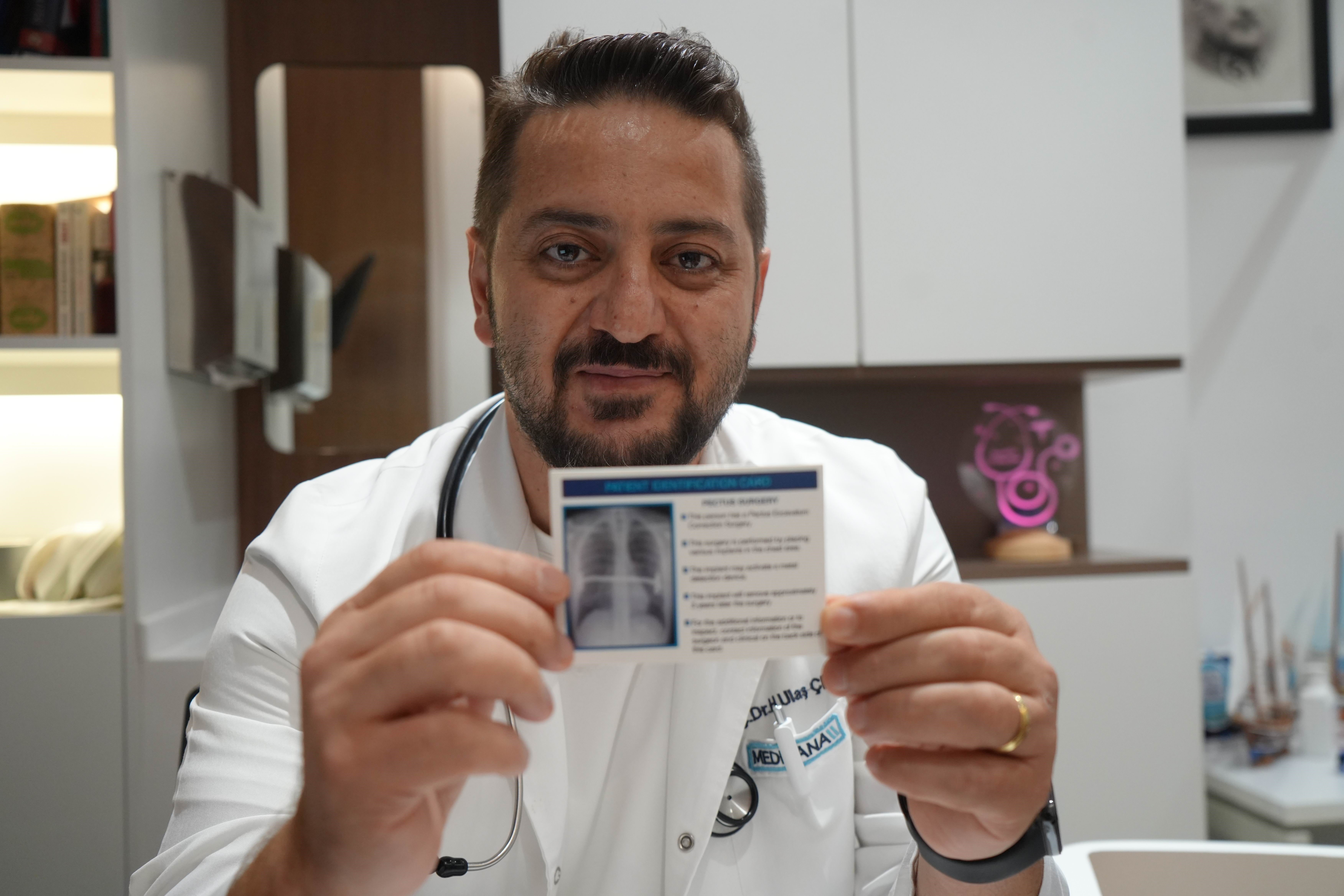
Patients who have undergone surgical operations to get rid of shoemaker (sunken) and pigeon (dislocated) chest diseases, which are among the most common chest wall deformities, continue their lives with a new identity card issued by their physicians. While patients cannot enter the MRI (MRI) device due to the metal attached to their breasts, they can pass through X-ray devices by showing the ID card given by their doctors.
In Turkey, a baby with a shoemaker's breast is born in every 300-400 births and a baby with a pigeon breast is born in every 1,500 births. Medicana Health Group Physicians, Thoracic Surgery Specialist Assoc. Dr. Hüseyin Ulaş Çınar stated that treatment is possible with a steel bar inserted into the chest in the treatment of patients with shoemaker and pigeon breasts. Stating that in the treatment of these diseases that disrupt lung and heart functions, they give necklaces, bracelets and ID cards to the patients to intervene in any emergency and to know that there is a steel bar in the chest, Assoc. Prof. Dr. Hüseyin Ulaş Çınar stated that they remove these steel bars after 3 years from the breasts that have achieved their natural form.
“Chest wall deformity can lead to serious health problems”
Pointing out that in addition to cosmetic discomfort, chest wall deformity can lead to serious health problems, Medicana International Samsun Hospital Thoracic Surgery Specialist Assoc. Dr. Hüseyin Ulaş Çınar said, “Chest wall deformities are a series of congenital diseases associated with deformities of the thorax. These deformities are characterized by abnormal development and appearance of the rib cage. Although these deformities are considered to be congenital, symptoms usually appear later in childhood and are recognized during adolescence. There are various degrees of chest wall deformities that can range from a simple cosmetic problem to serious health problems. The most common are shoemaker's (sunken) chest and pigeon (dislocated) chest. Congenital rib problems such as Jeune syndrome, which is less common, are also considered among chest wall deformities.”
“Shoemaker (sunken) chest is seen in 300-400 births”
Stating that shoemaker's chest is more common in chest wall deformities compared to other deformities, Thoracic Surgery Specialist Assoc. Prof. Dr. Hüseyin Ulaş Çınar said, “The most common shoemaker's chest among chest wall deformities is the inward collapse of the anterior chest wall. In this, it is characterized by excessive and uncontrolled growth of the cartilage ribs outward in the area where they are connected to the sternum, which we call the board of faith, and with this, the board of faith moves backwards. This disease is about 4 times more common in men than in women. It occurs in every 300-400 births. It occurs most frequently during adolescence, at the age of 14-15. Shoemaker's chest may be a disease on its own or it may be associated with kyphosis, scoliosis, Marfan syndrome and some diseases involving the musculoskeletal system. In the past, this condition has been incorrectly considered as a cosmetic defect only. Recent studies have shown that various heart and lung diseases are associated with this problem. Since the chest volume is considerably reduced in this deformity, the lung cannot expand sufficiently while breathing in and out and the lung capacity decreases accordingly. This can cause complaints such as severe chest pain, shortness of breath and rapid fatigue in the child. We also know that the pressure on the anterior chest wall can cause cardiac dysfunctions depending on the effect on the heart.”
“Surgical procedures performed at an early age may cause the disease to recur in the future”
Stating that timely surgical intervention is more effective in eliminating chest wall deformity, Assoc. Prof. Dr. Hüseyin Ulaş Çınar said, “Shoemaker chest treatments are divided into 2 as surgical and non-surgical. By placing the device called vacuum bell into the chest cavity, it is aimed to displace the depression in the chest cage outward. In surgery, open surgery is not used unless it is very necessary. Today, minimally invasive closed surgery is the standard method used. This method is applied at the beginning or end of puberty. We know that surgical corrections performed at an earlier age face the risk of recurrence of the disease in the future. It is also not applied in very young children except in very special cases. Both the ravitch procedure and the nuss procedure are performed under general anesthesia. Patients are hospitalized for 5-7 days. Both surgeries are painful procedures. Anesthetic painkillers used to relieve postoperative pain are among the number one factors of postoperative complications. Patients are discharged when their pain is sufficiently reduced with oral painkillers at home, they eat regularly, and there is no fever or signs of infection. After the discharge, after the first control, patients are called for control at 1-year intervals and their condition is checked.”
“Shoemaker's chest can be treated by attaching a steel bar to the chest”
Stating that the inverted chest is restored to its normal form with the steel bar attached to the chest, Assoc. Prof. Dr. Çınar said, “The nuss procedure, one of the most commonly used surgeries for the surgical correction of the shoemaker's chest, is applied. In this procedure, a steel bar, which is bent outside in accordance with the collapse of the rib cage, is passed through small incisions on the side of the rib cage, accompanied by a video camera, through the collapsed area under the rib cage, and rotated inside under the rib cage to displace the existing multilobularity outwards. At the end of the surgery, the steel bars are fixed to the ribs. Patients live with this bar for about 3 years. After 3 years, when the rib cage is sufficiently normalized, the bars fixed to the ribs are removed with a smaller operation. Children can play sports with the bar attached to the rib cage. Only close contact sports and traumatic sports are recommended to be avoided. We also do not recommend MRI with the bar. As long as the bar remains on the chest wall, we ask our patients to constantly carry an apparatus such as a necklace or bracelet that shows that this bar is on their body, as this bar will be an obstacle if it is necessary to intervene in the chest cage in case of a sudden health emergency.”
“Steel bar can also be worn on the pigeon chest”
Stating that they can treat pigeon chest deformity by attaching a steel bar as in the shoemaker chest, Çınar made the following statements:
“Another of the most common chest deformities is the pigeon chest problem. In this problem, it is a condition characterized by the abnormal and excessive outward development of the cartilage tissue in the area where the ribs are connected to the faith board and the faith board bone is positioned further forward than it should be. This is the problem of the chest protruding outwards. This is less common than shoemaker's. It occurs once in 1500 births and is more common in men. The place of surgical intervention is more limited in this disease. If started at an early stage, children with this disease can correct this deformity by using external pressure corsets. Since these corsets can only be worn for long periods of time and day and night, most patients have difficulty in adapting to them. If the chest wall dislocation does not stretch with the corset, if it is too hard, if the patient does not comply with the corset, surgical treatment comes to the agenda. In surgery, unlike the shoemaker's corset, a steel bar is inserted from the outside of the rib cage, not from the inside, under the pectoral muscles from the sides. It is fixed to the rib cage with various stabilizers. They are allowed to live with this bar for about 3 years. After 3 years, this bar is removed. This operation is called the abrahamson procedure. This operation is also a painful procedure. Most of the complications that may develop after surgery are related to the painkillers to be applied to relieve pain.”
“Patients must carry an identity card stating that they have a pectus bar on their body at all times”
Çınar also stated that the identity card given to patients who have a pectus steel bar attached to their bodies by surgery should be carried as long as the bar is attached, and said, “Our patients who will pass through the security corridor and devices should constantly carry an identity card indicating that they have a pectus bar on their body by their physicians in order to avoid problems at the airport and institutions.”
İHA Haber Kodu: 20240923AW292980